When Sports Meet Science
Human beings are capable of doing amazing things through sports. Look at sprinters running through the field or baseballs flying into the catcher's glove. The precision and power they show seem like magic. Whatever we do on earth, however, is governed by the rules of nature. In fact, science can explain a lot about the magic in sports.
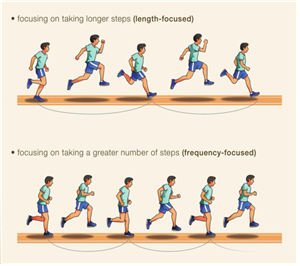
The problem for humans is that the harder they hit the ground, the more time they spend in the air, which makes their steps longer but reduces the number of steps they can take. Therefore, maximum running speed is attained when the combination of force applied to the ground and stride frequency is optimal.
Unfortunately, this combination also depends on the runner's size, leg length, and other factors that vary among individuals. Many experts predict, however, that a human being could probably run the 100-meter sprint in just over nine seconds. Maybe future technology will help runners run even faster than they do today.
How Fast Can a Human Run 100 Meters?
Usain Bolt, the Jamaican sprinter, broke the world record for the 100-meter sprint in 2009, clocking a time of 9.58 seconds. Animals like the adult cheetah can run 100 meters in about six seconds. So what is the limit to how fast a human can run 100 meters?
Sports scientists say that sprinters' speed is influenced by how hard they hit the ground with their feet and by how many steps they take. Cheetahs do not hit the ground as hard as humans, but they can take twice as many steps as we do. This is why they can run fast.
Why Do Curlers Sweep the Ice?
"Hurry! Hurry up!" Two people with brooms furiously sweep the ice in front of a rock that slides across a sheet of ice. "Whoa!" The sweepers stop as the rock settles into the house. "Nice job!" All four players bump fists indicating success. Have you guessed the sport? It's called curling.
One might expect that a curling stone sliding across the ice would continue in a straight line according to Newton's first law of motion. However, the stone will begin to curl when it loses its speed even though it is three or four times as heavy as a bowling ball. This is why players have to direct the stone's path carefully, and they do this by sweeping.
By rubbing the ice with the broom, the sweepers are generating heat to reduce friction between the stone and the ice. This results in the stone going straighter and farther. If the sweepers stop, the stone begins to curl again. Although the house—the area where the curlers aim the stone—is often blocked by an opponent's stone, curling teams can actually guide one stone behind another, which is one of the major strategic elements to the game. The precision with which the team can control the direction and speed of the stone is a major factor in the strategy of the game.
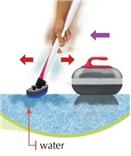
The heat generated by the sweeping melts the ice, which reduces friction. Reduced friction helps the stone move farther.
Why Does a Baseball Have Stitches?
The batter swings and hits a foul ball into the stands. You reach up with your glove and catch it as other spectators clap and cheer. You look at the baseball with its smooth leather covering and bright red stitches. Do the stitches serve a purpose other than to keep the leather covering over the ball?
A typical baseball has 108 double hand stitches. They serve more than just a decorative function. The stitches on a baseball actually affect the flight of the ball. Without them, a pitcher couldn't throw it as fast or as accurately.
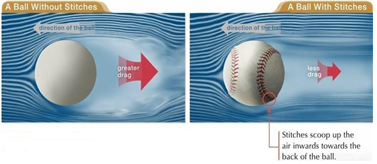
When a round object like a ball is thrown, the front part of the ball hits the air, increasing the air pressure there while the air becomes thinner at the back of the ball, making the air pressure low. This difference in air pressure creates an unwanted effect called "drag" that literally drags the ball backward and slows it down. This is where the stitches come into play.
The stitches more or less scoop the air and direct it inwards towards the back of the ball. This effectively increases the net air pressure at the back of the ball, which reduces the drag. Further, as a baseball is released, the pitcher can put spin on the ball. As the ball spins, the stitches help the ball to fly in the direction the pitcher intends.
Technology Doping
Doping in sports usually involves drugs that players illegally take to gain an unfair advantage in performance. As technology advances, however, doping is done not only with drugs but also with their equipment. That's why the term 'technology doping' was coined, referring to any form of unfair advantage gained from technology by a player or a team.
In the 2008 Olympic swimming competitions, when 23 out of 25 world records were set by those in a particular swim suit, investigations concluded that it was a case of technology doping. Recently, in a 2016 international cycling event, a cyclist from Belgium was accused of technology doping when a small machine was found inside her bike frame that gave her extra power while she pedaled.
A specially designed swim suit or a small device in a bicycle clearly gives an unfair advantage. They only discourage athletes who train day and night to improve their performance. Such attempts should be banned in all sports competitions. In order to preserve and promote the core value of fair competition among players, the governing bodies of various sporting events should seek measures to prevent technology doping from entering into their events. Technology has not been developed as an illegal weapon for gaining an unfair advantage. It is to be used as a tool for progress.